
Choose a position that keeps the door and any escape window usable, leaves a comfortable route to the bed, and fits the furniture you already have. Where there is a choice, a supported headboard and a view of the door without lying directly in its line are common feng shui preferences.
There is no single best wall for every small bedroom. A wardrobe, radiator, sloping ceiling, mobility need, or second sleeper can change which position is workable. Use those constraints to narrow the options before applying a placement preference.
Mark the things that cannot move.
On a simple sketch, mark the door swing, windows, fixed storage, heaters, and the bed's actual footprint. Include drawers and wardrobe doors when open. A bed can fit inside a room and still make the room difficult to use.
- Protect access first. Keep doors and escape windows unblocked. Do not trade away an exit to achieve a preferred layout.
- Check the everyday route. Trace how each sleeper reaches the door, storage, and their side of the bed. Measure for the people and access needs in your home; a generic diagram cannot determine that clearance.
- Compare the remaining walls. A solid headboard wall can be a useful starting point. Check window operation, drafts, heater clearances, and fittings before choosing a window wall.
Two layouts, two different tradeoffs.
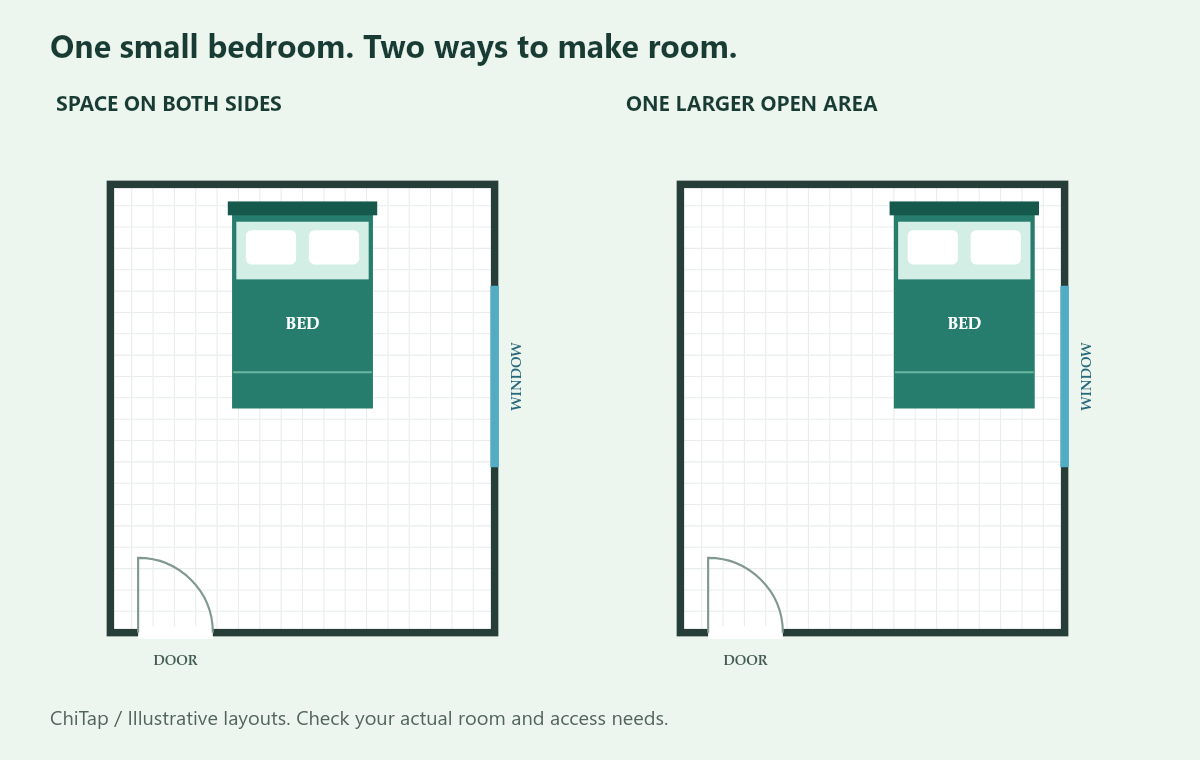
Centered on the back wall
This example offers room on both sides of the bed. It can be a useful option for two sleepers, provided the actual room width allows it. Check whether the headboard overlaps a window and whether furniture at the foot of the bed narrows the route out.
Offset toward one side
An offset bed creates one larger open area, which may help a single sleeper in a tight room. The tradeoff is a narrower bedside. For a shared bed, check that neither person has to climb over the other or navigate an unusable gap.
In these examples the door stays in the same place. Moving the door or adding a wardrobe could change the choice. The illustration is a comparison, not a universal recommended layout.
When the bed has to stay.
Keep a workable bed position and improve the space around it. Clear the bedside-to-door route, move a loose cable out of the walkway, or reduce what sits on the bedside surface. Check that drawers and doors open without hitting the bed.
Do not add a screen, bench, plant, or decorative object in a narrow route just to satisfy a feng shui rule. If the only available arrangement has a compromise, acknowledge it and prioritize the room's actual use.
Compare your own starting point.
Select your bed, door, and window positions. The free check compares illustrative options and includes a keep-the-bed-in-place path.
Check my bedroomApproach and sources
This guide uses common form-based feng shui placement ideas alongside practical access checks. It does not calculate compass directions, a birth chart, or a guaranteed outcome. Different feng shui schools may interpret placement differently.
Anjie Cho: De-Stress Your Bedroom: Feng Shui Style describes the preference for seeing the door without being directly in line with it. We use that as a cultural placement idea, not a medical claim.
U.S. Fire Administration: Home Fire Escape Plans advises keeping doors and windows unblocked. Follow applicable local safety requirements and any personal access needs.
Text and diagrams by Rabo X Studio. Corrections: raboxstudio@gmail.com.